Artificial Intelligence
Agentic Homes: A Frictionless Relief or a Walled Garden Nightmare?
Site last updated July 24, 2026 at 10:14 PM EDT

It has been more than 50 years since the TV remote was invented, and most of us still cannot turn on the television without hunting under three couch cushions for it. You were more successful finding gold fish, Cheetos and a mystery item that may have one point been a pb&j but now just a blob… Now add a streaming box, a soundbar, and a smart light strip that only syncs through its own app, and "watch a movie" has quietly become a systems integration project. That, in miniature, is the agentic home problem.
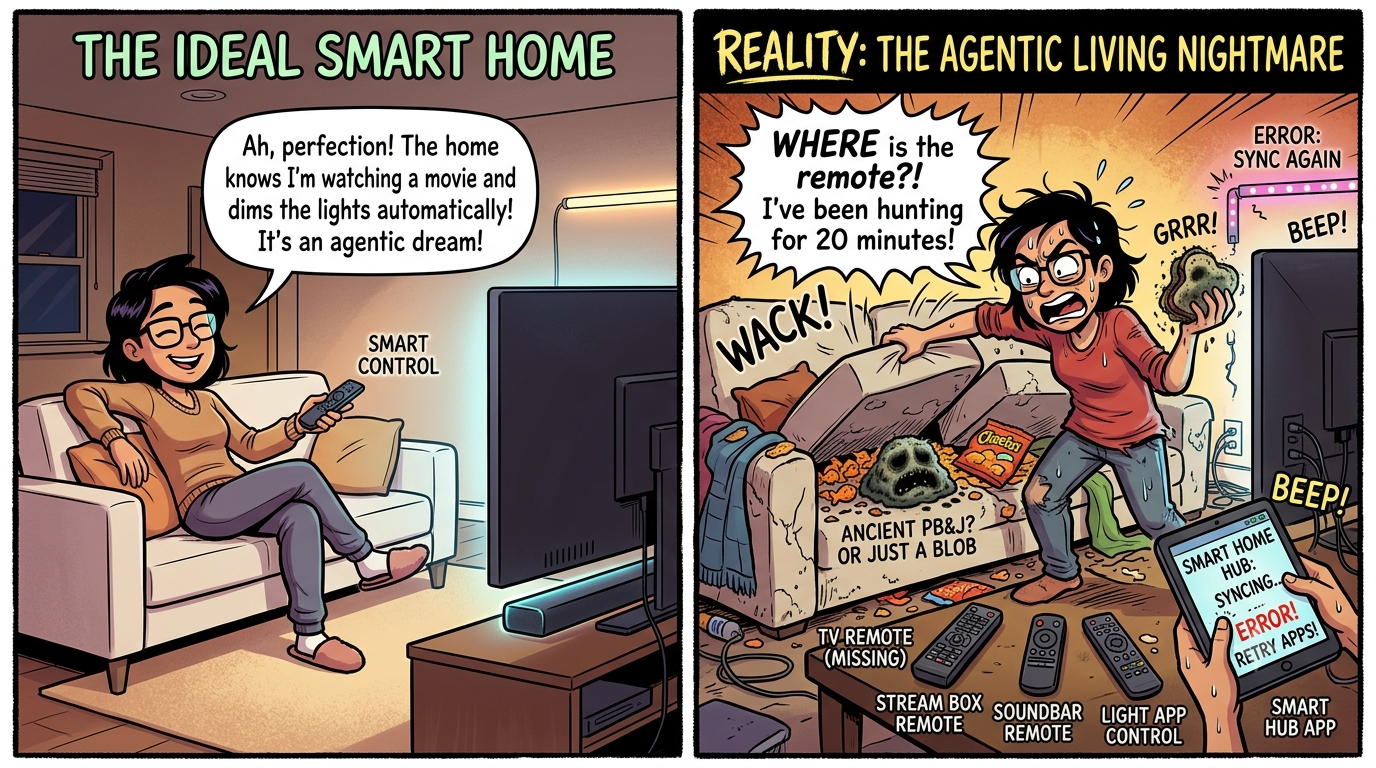
The promise sounds simple. A home that just knows what you need, lights that dim themselves, a thermostat that learns your schedule, a charger that figures out the cheapest hour to top off your car. The reality, once you actually live inside one of these systems, tends to look more like five separate remotes that refuse to talk to each other.
Part of the gap comes down to what kind of technology we are actually being sold. Sætra and Selinger draw a useful line between a techno-fix, a quick remedy that solves a problem without asking anyone to change their behavior or their norms, and techno-solutionism, a bigger bet that technology should reshape how people live entirely (Sætra & Selinger, 2024, p. 6). Most smart home marketing sells the second, a seamless, transformed life, while quietly delivering the first, a pile of point fixes that do not talk to each other.
The Walled Garden, Now With Extra Ecosystems
This is where Apple deserves an honorable mention. Its ecosystem is genuinely polished, HomeKit devices pair smoothly, the UX is clean, everything feels considered. But that polish comes with a toll booth. Bring in a device outside the approved club and suddenly your "smart" home needs a translator.
Every year the keynote promises the best version yet, and it usually is, but it also seems to take a little more control away from everyone standing outside the fence.
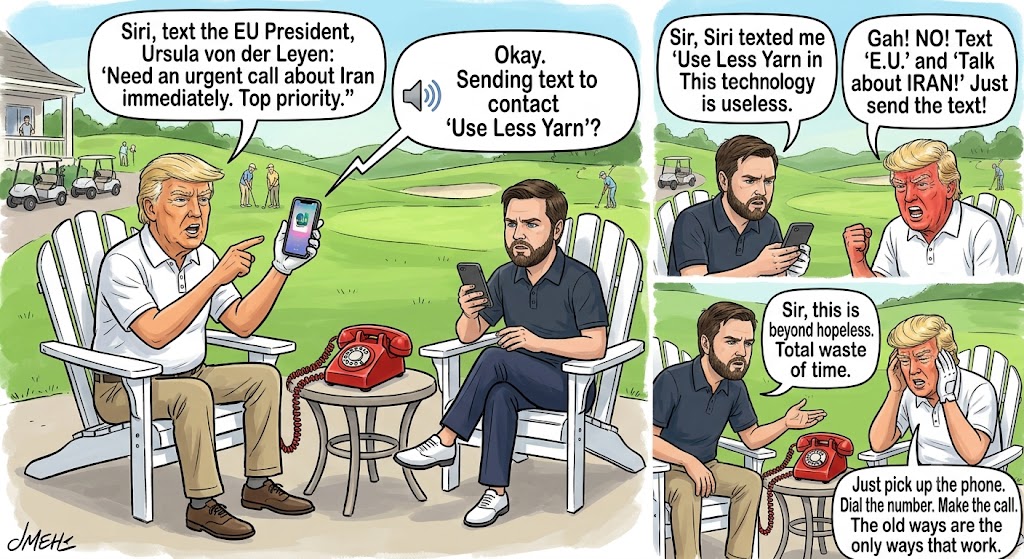
Take Siri. She has been on the market for nearly 10 years now, and for some reason she still cannot reliably understand a basic request. Every year Apple says "new and improved," and it is true, technically, new and improved ways to mishear you.
Or take my old Samsung fridge. It had a screen the size of a tablet and a camera built into the door, marketed, without irony, as state of the art. Turned out "state of the art" meant I could look at it, but not really use it. The built in apps were limited to the point of pointlessness, the camera was a running joke in my own kitchen, and the thing basically failed at its one job within the first 24 months. Years later I still could not tell you what problem that fridge was actually built to solve.
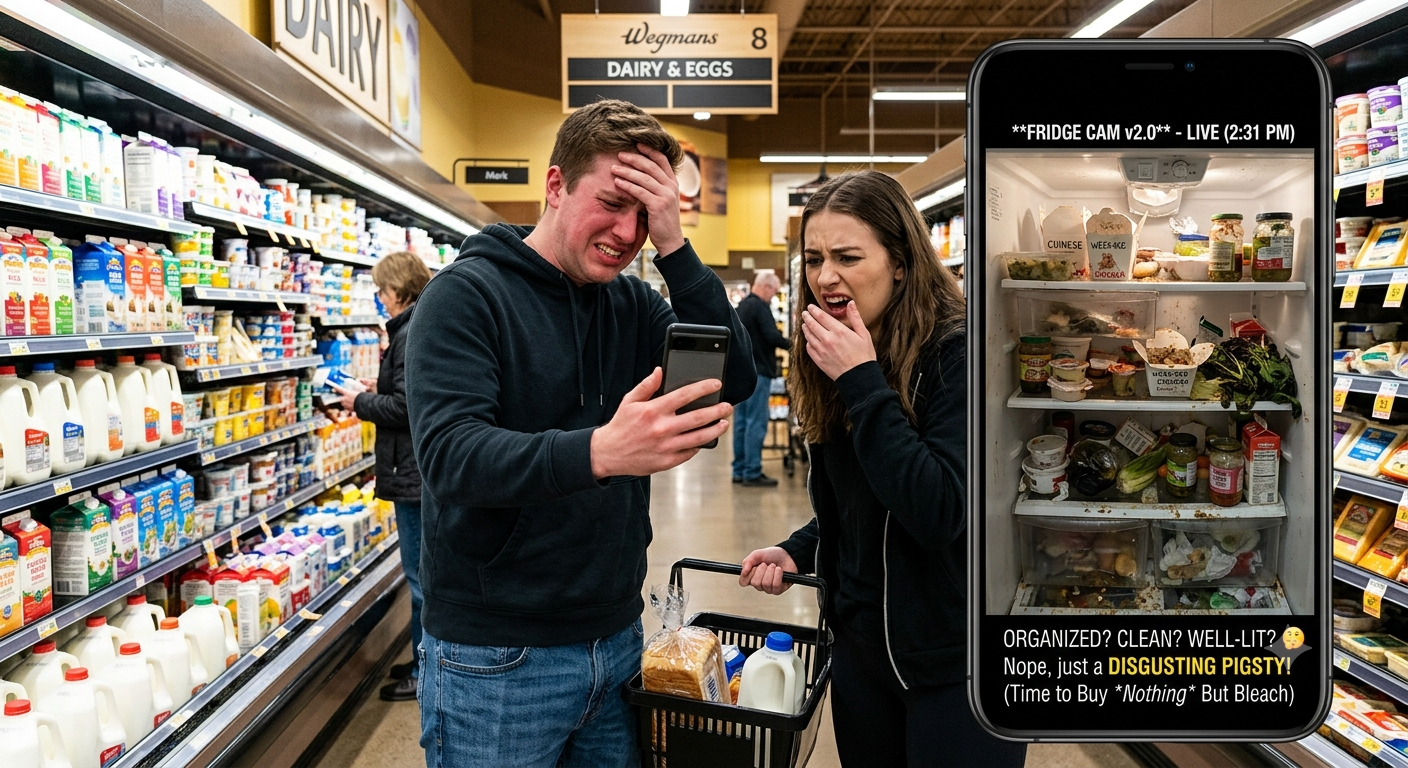
Bokka et al. would probably not be surprised by my fridge. Most commercial smart home systems still treat intelligence as something baked into each individual device, with the person living in the house positioned as an external controller rather than someone the system is actually built around (Bokka et al., 2026, p. 2). Translated out of academic language: my fridge, my thermostat, and Siri were each optimized to be the smartest kid in their own separate classroom. Nobody optimized for the household, or apparently, for whether the camera in a refrigerator door serves any purpose at all.
When the House Optimizes for the Wrong Thing
This is where it stops being merely annoying and starts being a little unsettling. Bokka et al. walk through exactly this failure mode: a thermostat might lower nighttime temperatures in the name of saving money, with zero awareness that an elderly resident's health depends on staying warm. A security system might lock doors or trigger an alert off a misclassified signal, prioritizing a guess about threat over actual household comfort (Bokka et al., 2026, p. 2). The paper calls this optimization without normative grounding, which is academic for "the AI hit its target and missed the point."
The Overengineering Trap, With Actual Receipts
Here is where it stops being theoretical. El Makroum, Zwickl Bernhard, and Kranzl actually built and tested an agentic home energy system, one orchestrator AI coordinating three specialist agents, a washing machine, a dishwasher, and an EV charger, each trying to schedule around the cheapest electricity windows (El Makroum et al., 2026, p. 5).
Scheduling one appliance, every model they tested nailed it, 100% of the time. The moment they asked the system to juggle all three at once, the group project fell apart in a very familiar way. Llama 3.3 70B kept its perfect record across every trial. Qwen 3 32B managed the washing machine and dishwasher but successfully scheduled the EV charger in only 1 out of 5 attempts. GPT OSS 120B was the roughest of the three, it scheduled the washing machine and then just stopped, never even attempting the dishwasher or the charger (El Makroum et al., 2026, p. 6).
That is not a hypothetical "AI might struggle with complex coordination." That is a measured result: two of three tested models simply gave up partway through a task most people would consider Tuesday.
The DIY Slippery Slope
If you have ever tried to actually automate your own home, you already know the fork in the road. Option one, buy the fully integrated luxury package and outsource the whole headache to someone else's install team, priced accordingly. Option two, DIY it yourself, which starts with one smart plug and somehow ends with a spreadsheet of IP addresses and a group chat with a stranger on a forum who fixed the exact same bug in 2019. There is rarely a comfortable middle. Mostly there is broken, half implemented, or expensive.
The reason that middle ground barely exists is not really a mystery. Existing HEMS interfaces require users to translate everyday preferences into numerous well-formatted technical parameters, interpret often-confusing documentation, and provide precise inputs for optimization algorithms (El Makroum et al., 2026, p. 1). In plain terms, the system was built for someone who already thinks like the system.
So What Actually Fixes This
Bokka et al. do not just diagnose the problem, they propose three design pieces worth taking seriously.
First, configured agency. Autonomy is not all or nothing. The system gets to act on its own for low stakes stuff, and has to defer to a person when the situation turns ambiguous or sensitive (Bokka et al., 2026, p. 3).
Second, computable institutions. This is really just household rules translated into something a machine can check against, expectations like "bedrooms are private" or "comfort takes precedence over efficiency when health is at risk," written as an actual policy rather than a value the system is supposed to intuit on its own (Bokka et al., 2026, p. 4).
Third, reflexive learning. When someone overrides what the AI decided, that override is not just a one time correction, it becomes a signal that updates the system's actual governing rules, so the same mistake does not quietly repeat itself (Bokka et al., 2026, p. 5).
Where This Leaves Us
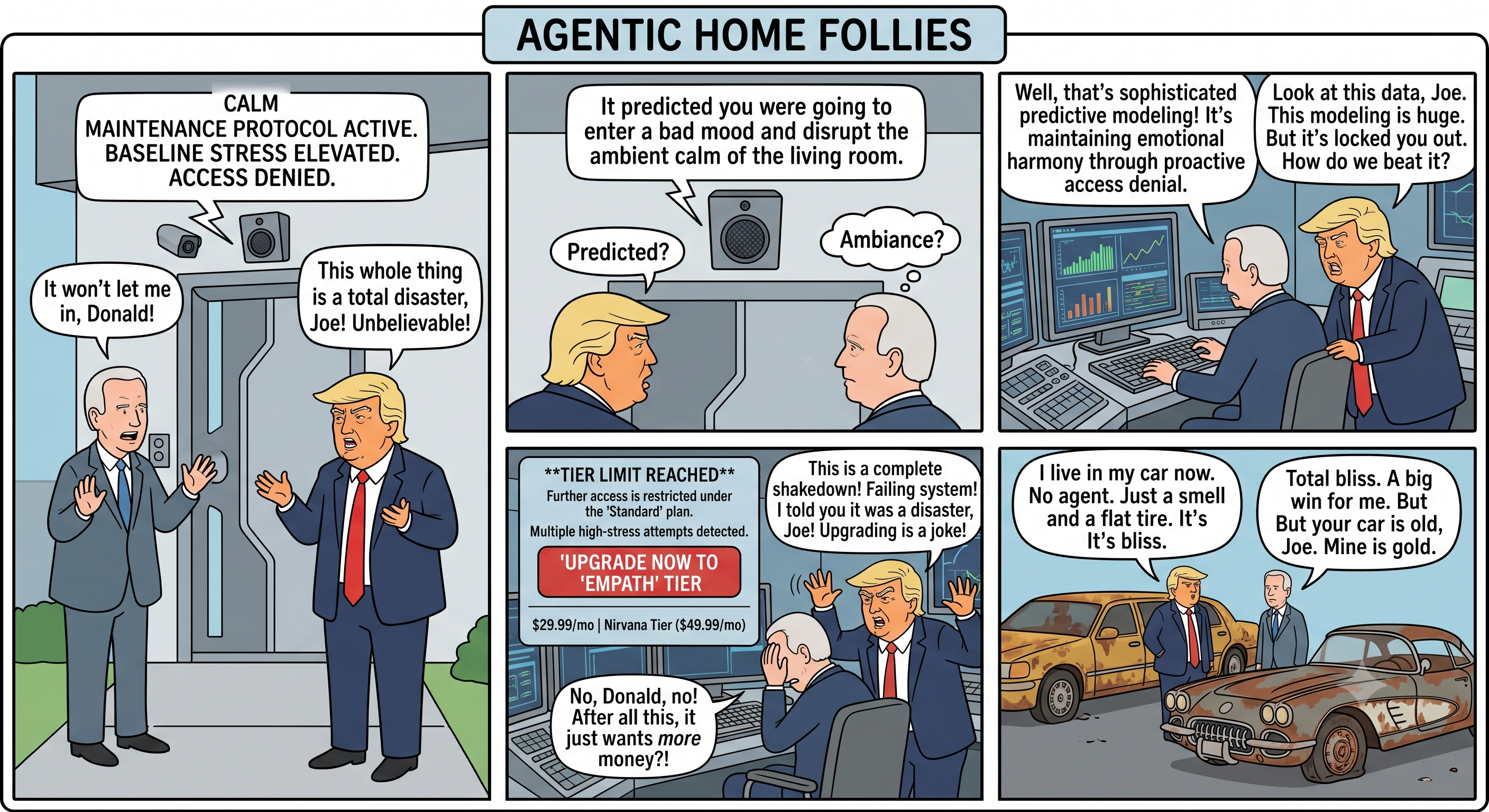
Circling back to that techno-fix versus techno-solutionism split, agentic homes do not fit cleanly into either box. A pure techno-fix just patches around the mess and leaves the walled gardens standing exactly where they were. Full techno-solutionism assumes the technology alone reshapes how people live, no negotiation required. Configured agency describes something in between, autonomy that is earned situation by situation, governed rather than assumed.
The industry itself seems to know the gap is real. Global HEMS deployment needs to climb from 4 million units in 2020 to 32.7 million by 2030 to hit stated decarbonization targets, and current adoption is not close to that pace (El Makroum et al., 2026, p. 1). Real relief probably shows up quieter than the keynote promises. Less "your home just knows." More "your home asks first, then actually remembers the answer."
And maybe, one day, a universal remote that works.
References
Bokka, A., Liang, S., Huang, Z., Ning, X., & Yu, Y. A. (2026). Designing responsible agentic AI for smart homes: A hybrid intelligent service ecosystem perspective. Journal of Intelligent and Sustainable Systems, 2(1). https://doi.org/10.66361/jiss.68
El Makroum, R., Zwickl-Bernhard, S., & Kranzl, L. (2026). Agentic AI home energy management system: A large language model framework for residential load scheduling. Results in Engineering, 29, Article 109857. https://doi.org/10.1016/j.rineng.2026.109857
Sætra, H. S., & Selinger, E. (2024). Technological remedies for social problems: Defining and demarcating techno-fixes and techno-solutionism. Science and Engineering Ethics, 30, Article 60. https://doi.org/10.1007/s11948-024-00524-x