Artificial Intelligence
The Rise of Agentic Software Development Platforms
Site last updated July 24, 2026 at 10:14 PM EDT

The software development landscape is going through a real architectural shift this year. The industry is moving past simple AI code completion tools, the "copilots", and converging on something bigger: autonomous "agentic" platforms that don't just suggest code, they run the whole loop themselves. As this scales, engineering workflows, cost structures, and enterprise risk are all moving with it.
What Is an Agentic Software Development Platform?
The clearest way to think about it: a copilot completes code inside a file based on what you type. An agent works from a high level goal instead. It can independently read a repository, write code, run terminal commands, execute tests, make commits, and open pull requests, without someone sitting there prompting it step by step.
By 2026, this space has settled into three recognizable shapes:
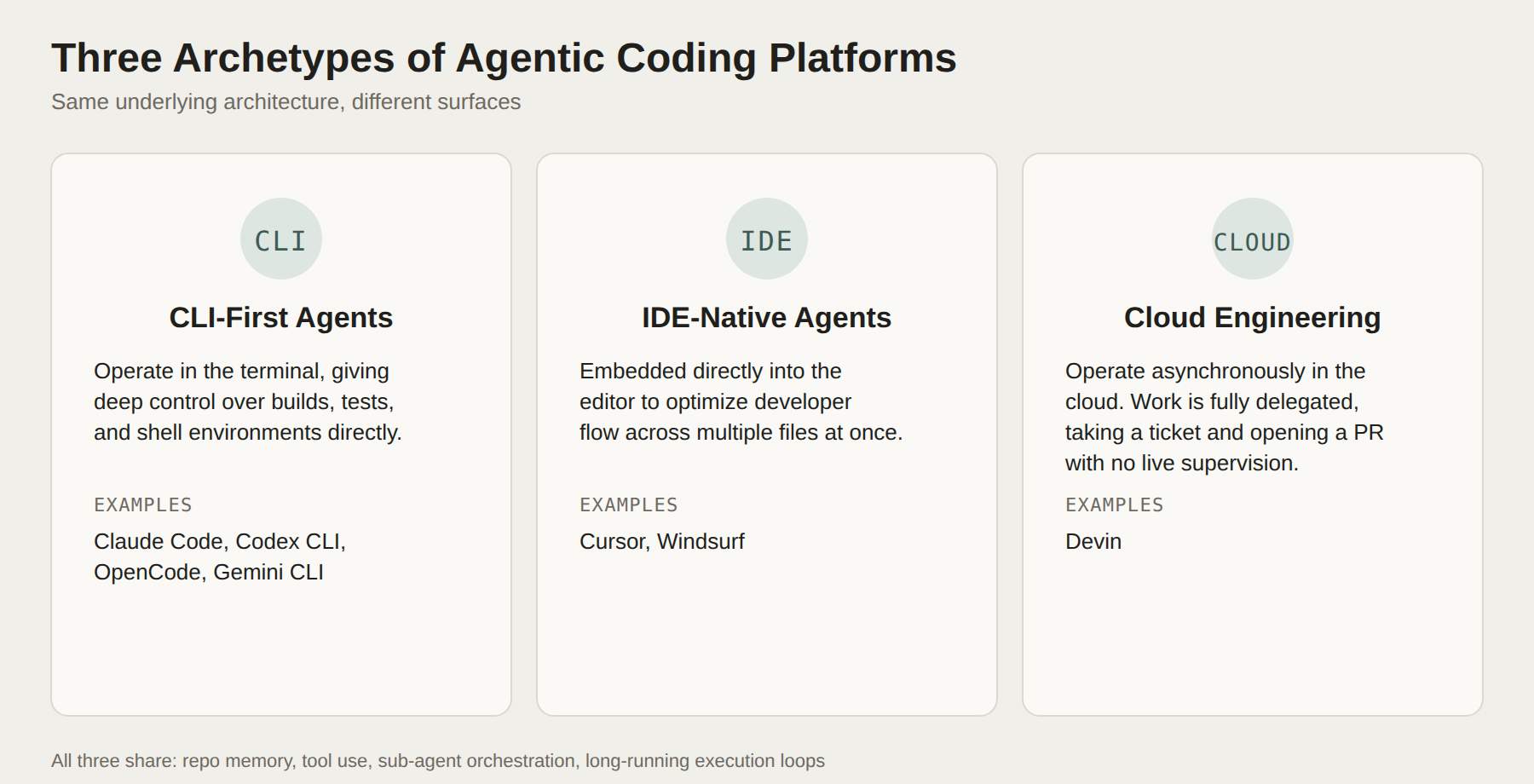
- CLI-first agents (Claude Code, Codex CLI, OpenCode, Gemini CLI): live in the terminal, with deep control over builds, tests, and the shell itself
- IDE-native agents (Cursor, Windsurf): embedded directly in the editor, optimized to keep a developer's flow intact across multiple files at once
- Cloud engineering agents (Devin): run asynchronously, work gets fully delegated, the agent takes a ticket and opens a PR with no one watching in real time
Different surfaces, but the same underlying architecture underneath all three: repo memory (files that explain project conventions), tool use (Git, browsers, package managers), sub-agent orchestration (planning, coding, and testing agents working together), and long execution loops that let an agent iterate on a problem over minutes or hours.
The Market, as of Mid-2026
The growth here has genuinely outpaced most published research on it, worth updating with the most current numbers rather than repeating older figures that are already stale.
Cursor's trajectory is the standout. It crossed $1 billion in annualized revenue in November 2025, then $2 billion by February 2026 (Bloomberg, reported via TechCrunch). Its November 2025 Series D raised $2.3 billion at a $29.3 billion valuation. By May 2026 it had reached $4 billion ARR, and in June 2026 SpaceX announced a definitive agreement to acquire the company for $60 billion in an all-stock deal. That's a path from $100 million to $4 billion in ARR in about 16 months, one of the fastest revenue climbs recorded for a B2B software company.
OpenAI's Codex passed 5 million weekly active users in June 2026, up from roughly 600,000 at the start of the year. About 1 in 5 of those users are now knowledge workers rather than developers, a category OpenAI says is growing three times faster than the developer segment. Internally, OpenAI's own research paper on the shift ("The Shift to Agentic AI: Evidence from Codex") reports that 97.9% of its employees now use Codex, up from about 40% in August 2025, worth noting this is self-reported, and OpenAI's own paper flags that its internal conditions aren't representative of typical enterprise adoption.
GitHub Copilot remains the widest distributed tool, with nearly 80% of new developers on GitHub using it within their first week, per GitHub Universe 2025. It holds the largest share of paid users in the category, roughly 42% by subscriber count, though by active work adoption its lead has narrowed, GitHub Copilot, Cursor, and Claude Code have converged closer together in 2026 than they were a year earlier.
Cost: Platform Pricing vs. the Real Cost of Verification
Pricing for these tools spans a wide range depending on the harness and deployment model:
- Entry level and open source: Gemini CLI and OpenCode offer free or open access, paying only for API usage. OpenAI's Codex "Go" tier starts at $8/month.
- Professional and enterprise tiers: Claude Code and Cursor run roughly $20 to $100+/month depending on usage limits, with Cursor's top "Ultra" tier reaching $200/month. Devin runs $20 for its Pro tier up to $200 for Max.
Token costs per task are the harder number to pin down, since they scale with context size and how much parallel "sub-agent" work a task requires. Reports from 2025 put the average cost of generating a full feature branch through an agentic workflow somewhere between $50 and $200. At the extreme end, highly parallel workloads can spike fast, one widely cited example is Google's agents autonomously building a working OS capable of running Doom, reportedly using 93 subagents and 339 million input tokens for a single run. That specific figure comes from a single reported case rather than something independently reproduced, worth treating as illustrative of the ceiling rather than a typical cost.
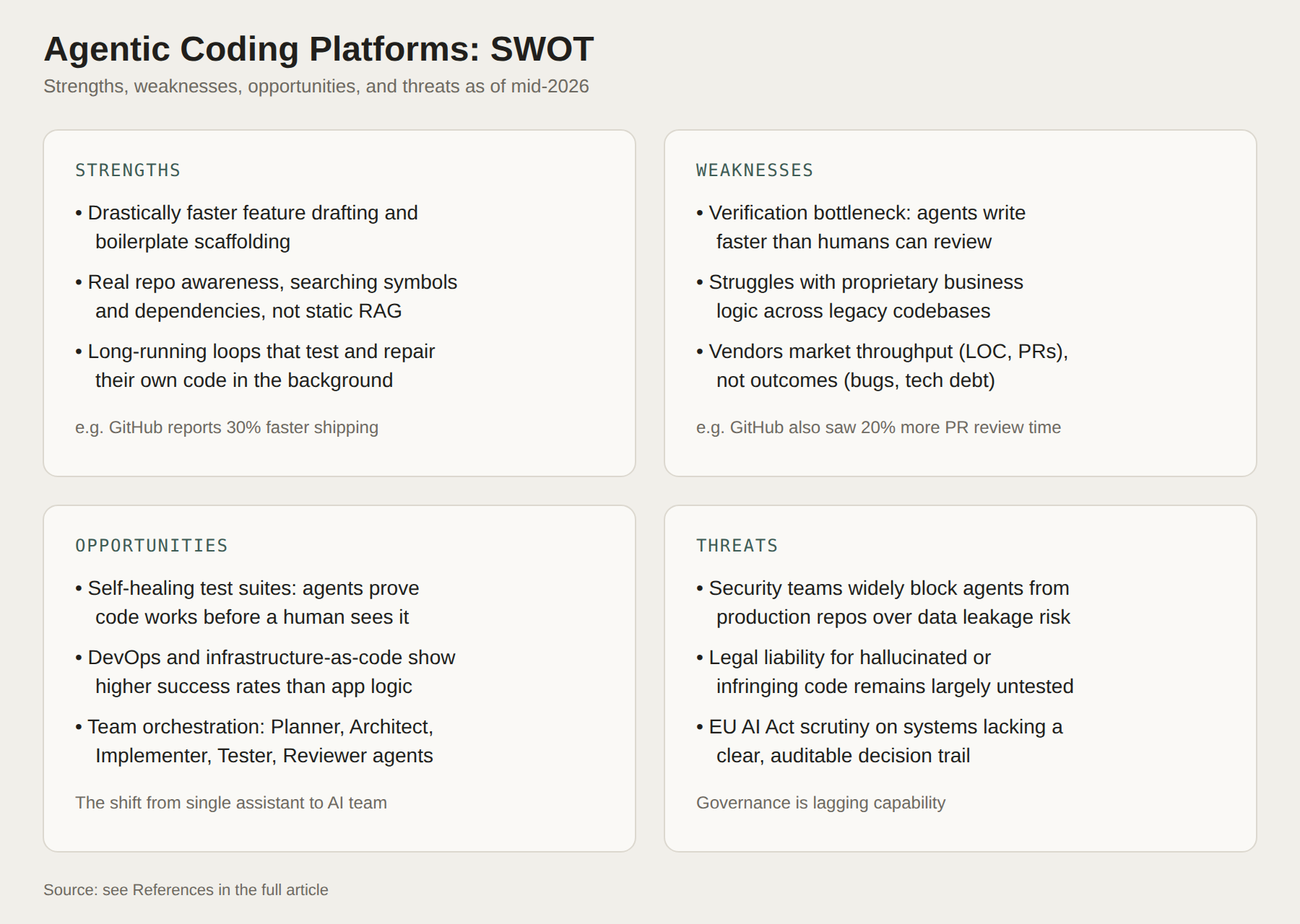
The real story is what happens after generation. GitHub's own data shows AI coding tools helped teams ship features roughly 30% faster, but also saw a corresponding rise in PR review time. That's the productivity paradox in a sentence: code generation sped up faster than an organization's capacity to verify it did. A number of engineering teams are responding by budgeting for dedicated review capacity, sometimes described informally as "AI reliability engineers," curating prompt libraries and evaluation sets rather than assuming agent output can go straight to production. The honest read on where the industry actually is right now: augmentation, not full replacement of human engineers.
Strengths, Weaknesses, Opportunities, Threats
What to Watch: Lock-In, Rate Limits, and Paywalls
As the underlying frontier models converge toward similar capability, the real competition has shifted to the "harness", the wrapper, tools, and workflow surface that actually executes an agent's logic. That shift is exactly why vendors are leaning harder into rate limits and lock-in.
Usage throttling is a real, common complaint. Reports describe aggressive rate-limit lockouts even on paid tiers for some platforms, and mid-stream usage cuts that mean an advertised monthly price doesn't reflect how much sustained work you can actually get done before hitting a wall.
Proprietary configuration creates real switching costs. Agents lean on files like .cursor, CLAUDE.md, or GEMINI.md, plus platform-specific lifecycle hooks, Claude Code alone documents around 30 programmable lifecycle events. Once a team's workflow is built around one platform's specific memory architecture, moving to a competitor is a genuine engineering project, not a subscription swap.
Free tiers are actively shrinking as compute costs rise. The clearest example: Google is retiring the open-source Gemini CLI on 18th June 2026 in favor of a closed-source successor, ending free individual access.
The Case for Open, Non-Paywalled Systems
Given that lock-in pattern, the open-source alternatives matter more than they might have a year ago. OpenCode, maintained by Anomaly, is the clearest example, MIT licensed, and by mid-2026 had crossed roughly 178,000 GitHub stars with more than 7.5 million monthly users, making it the most-starred open-source coding agent in the category, ahead of Claude Code, Gemini CLI, and Codex CLI's own open-source release.
What it actually offers that closed platforms don't:
- Model agnosticism: over 75 model providers supported, Anthropic, OpenAI, Google, GitHub Copilot passthrough, and local models, switch with a flag rather than a migration
- Data sovereignty: runs via a headless server that can be fully self-hosted, which matters directly for the security teams wary of sending proprietary code to a third party model provider
- Stack ownership: a model that writes code is a commodity. A model that owns the deployment pipeline is a strategic asset. Open systems keep that pipeline owned by the engineering org, not the vendor.

Where This Leaves Things
The shift from pair-programming to autonomous AI engineering teams is a genuinely significant moment in how software gets built. But the headline valuations, Cursor's climb toward a $60 billion acquisition chief among them, shouldn't be read as evidence that these tools are 1:1 replacements for engineers. They aren't yet, and the gap between "generates code fast" and "generates code an organization can trust in production" is exactly where most of the real work is happening right now.
For any team actually deciding whether to adopt one of these platforms, the useful question isn't the marketing number, the "2x to 10x" productivity multiplier on a slide. It's quality-adjusted throughput, work done, verified, and shippable, not just tokens generated. Until automated verification catches up to generation speed, the engineers on your team aren't being replaced by these tools. They're becoming the people who manage them.
That verification gap, the space between "the agent shipped it" and "the org can actually trust it," is the exact problem I've been digging into for a white paper coming next week. If the tension in this piece is one you're living with on your own team, keep an eye out, and follow along at 4rged.ai for the full breakdown when it's live.
References
- Axis Intelligence. (2026). GitHub Copilot statistics 2026: Users, revenue, market share & AI coding data. Retrieved July 2026, from
https://axis-intelligence.com/github-copilot-statistics/ - Business Wire. (2025, November 13). Cursor secures $2.3 billion Series D financing at $29.3 billion valuation to redefine how software is written. Retrieved July 2026, from https://www.businesswire.com/news/home/20251113939996/en
- Get Panto. (2026). OpenAI statistics 2026: Users, revenue & market share. Retrieved July 2026, from https://www.getpanto.ai/blog/openai-statistics
- Let's Data Science. (2026, April 21). Cursor $2B funding round at $50B valuation. Retrieved July 2026, from https://letsdatascience.com/blog/cursor-2-billion-funding-round-50-billion-valuation
- Nerd Level Tech. (2026). OpenCode: The open-source AI coding agent explained (2026). Retrieved July 2026, from https://nerdleveltech.com/opencode-open-source-ai-coding-agent-explained
- OpenAI. (2026, June 25). The shift to agentic AI: Evidence from Codex. Retrieved July 2026, from https://arxiv.org/html/2606.26959v1
- Pinggy. (2026, May 25). Best open source CLI coding agents in 2026. Retrieved July 2026, from <https://pinggy.io/blog/best_open_source_cli_coding_agents/ >
- TechCrunch. (2026, April 17). Sources: Cursor in talks to raise $2B+ at $50B valuation as enterprise growth surges. Retrieved July 2026, from https://techcrunch.com/2026/04/17/sources-cursor-in-talks-to-raise-2b-at-50b-valuation-as-enterprise-growth-surges/
- TechBriefly. (2026, July 1). Codex use is spreading into knowledge work, OpenAI says. Retrieved July 2026, from https://techbriefly.com/2026/07/01/codex-use-is-spreading-into-knowledge-work-openai-says/