Platform Thinking
Why Platform Thinking Needs Enterprise Architecture
Site last updated July 24, 2026 at 10:14 PM EDT

Why Platform Thinking Needs Enterprise Architecture
And how strong architectural foundations prepare an organization for agentic AI
Every platform team I've been part of eventually runs into the same wall. The roadmap is clear, the backlog is prioritized, the team is capable, and the platform still can't move fast without breaking something two teams over. Almost every time, the real cause isn't the roadmap. It's the architecture underneath it, or the absence of one anybody agreed on.That's what this piece is actually about. Enterprise Architecture, EA, gets treated as a compliance exercise or an ivory tower diagram nobody reads. In practice, it's the discipline that decides whether platform thinking works at all, and increasingly, whether an organization is even structurally capable of adopting agentic AI. Those two things turn out to be the same conversation.
What Enterprise Architecture Actually Is
EA is the discipline of designing how an organization's strategy, business processes, data, applications, and technology fit together as one coherent system instead of a pile of disconnected projects. Think of it as city planning instead of building one house at a time. A single house architect cares about one structure. A city planner decides where roads go, where utilities run, where zones for housing versus industry sit, so that every future building someone constructs fits into a working whole instead of creating gridlock five years later.
For a product or platform leader, EA matters because it's the layer above your roadmap. Your platform lives inside someone else's city plan whether you've ever read it or not.
Core Principles of Good Architecture
Good architecture, regardless of framework, tends to share a small set of recurring principles, and each one maps directly onto what makes a platform actually work.
- Business alignment first: Architecture exists to serve business outcomes, not the other way around. A technically elegant design that doesn't map to a business capability is wasted effort.
- Reusability over duplication: The pattern behind any strong data platform, one shared system instead of a separate build per team, is an architecture principle in action. Good architecture actively looks for what can be built once and reused, rather than rebuilt per team or per product.
- Loose coupling, clear contracts: Components should depend on well-defined interfaces, not on each other's internal implementation, so each side can change independently without breaking the other. This is the exact principle that later makes a system safe for an AI agent to call.
- Single source of truth: Master data should exist in one authoritative place, with everything else treating it as a read source rather than maintaining its own competing copy.
- Evolvability over perfection: A good architecture assumes change is constant and is judged by how cheaply it absorbs that change, not by how complete it looked on day one.
- Governance with teeth: Principles without enforcement become suggestions. Definition of Done gates, architectural review boards, and acceptance criteria are what make architecture real rather than aspirational.
The Major Frameworks
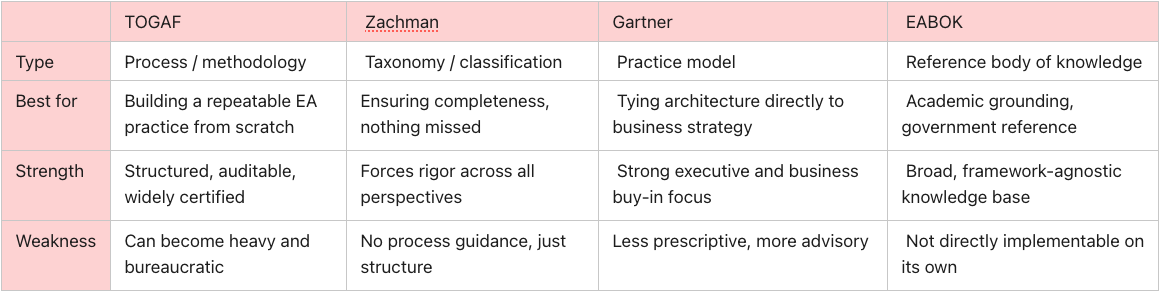
TOGAF
TOGAF, The Open Group Architecture Framework, is among the most widely adopted EA frameworks in large enterprises and government (The Open Group, 2018). Its core is the ADM, the Architecture Development Method, a repeatable cycle moving through architecture vision, business architecture, information systems architecture, technology architecture, opportunities and solutions, migration planning, implementation governance, and architecture change management.TOGAF is process-heavy and methodical. It's popular in large, bureaucratic organizations that need a defensible, repeatable, auditable process.
Zachman Framework
Zachman isn't a process, it's a classification grid. Originally published as a framework for information systems architecture (Zachman, 1987), it organizes architecture artifacts across two dimensions, six questions (what, how, where, who, when, why) and six perspectives, from the highest strategic view down to the running system. Zachman doesn't tell you how to do architecture, it tells you how to make sure nothing important got skipped. It's often used alongside another framework rather than standalone, a completeness checklist layered on top of TOGAF's process or an organization's own method.
Gartner EA Framework
Gartner's approach is less a rigid methodology and more a practice model centered on business outcomes and continuous adaptation. Where TOGAF emphasizes a structured, artifact-driven process, Gartner emphasizes EA as a bridge between business strategy and IT execution, with heavier focus on stakeholder engagement and demonstrating direct value to leadership.
EABO
EABOK, the Enterprise Architecture Body of Knowledge, was developed by the MITRE Corporation in the early 2000s to organize and characterize the knowledge content of the EA discipline (MITRE Corporation, 2004). It functions as a reference body of knowledge rather than a prescriptive method, closer in spirit to how PMBOK works for project management. The EABOK Consortium that maintained it ceased active operations in 2020, and the archive remains a widely cited historical and academic reference (EABOK Consortium, 2020).
Side-by-Side Comparison
Which Framework Fits Which Industry
Government and defense lean on TOGAF for its auditability across large, multi-agency programs, with EABOK showing up as a reference standard. Financial services and insurance follow the same pattern, often pairing TOGAF with Zachman to guarantee compliance artifacts aren't missing anything. Fast-moving tech and product-led companies tend to find full TOGAF too heavy, borrowing Gartner's business-outcome philosophy and applying a lightweight, pragmatic subset instead, governance and Definition of Done gates without a formal ADM cycle running underneath. Healthcare typically blends TOGAF for regulatory and interoperability requirements with Zachman layered on top, since the cost of missing a perspective in a patient safety context is unusually high.
Types of Enterprise Architecture

Most frameworks organize EA into the same four core layers, with a fifth increasingly treated as its own discipline:
-
Business Architecture - The organization's strategy, capabilities, and operating model. What the business does and why.
-
Data Architecture - How data is structured, stored, governed, and flows across the organization. Your master data stores live here.
-
Application Architecture - The individual applications and services, and how they interact.
-
Technology Architecture - The underlying infrastructure, compute, storage, and networking everything else runs on.
-
Security Architecture - Increasingly a fifth layer rather than folded into technology, governing identity, access, and data protection across every other layer simultaneously.
Single source of truth becomes the difference between an agent acting on the real customer record and an agent confidently acting on a stale duplicate nobody remembered to deprecate.
Why Platform Thinking Actually Needs This
Platform engineering has moved from a niche practice to a mainstream expectation fast. Gartner projects that 80% of large software engineering organizations will establish dedicated platform teams by 2026, up from 45% in 2022 (Gartner, 2026). The vocabulary for how those teams organize, stream-aligned teams, platform teams, enabling teams, comes directly from Skelton and Pais's Team Topologies (Skelton & Pais, 2019), and the product platform teams build is usually called an Internal Developer Platform, or IDP, a self-service layer of APIs, tools, and golden paths that reduces cognitive load for every team building on top of it.
Here's the part that doesn't get said enough: an IDP is not a tool you buy, it's an application of the same EA principles above, just aimed inward at your own engineering organization instead of outward at the business. Loose coupling and clear contracts are what make a golden path safe to pave. A single source of truth is what keeps every team building on the platform from silently drifting out of sync with each other. Governance with teeth is what keeps a platform's paved roads actually paved, instead of quietly eroding back into every team building their own snowflake pipeline six months later.
Platform thinking without architectural discipline behind it doesn't fail loudly. It fails slowly, one exception and one workaround at a time, until the platform is just as fragmented as the mess it was built to replace.
The Path This Paves to Agentic AI
This is where the stakes get higher, fast. Gartner projects that 40% of enterprise applications will embed task-specific AI agents by the end of 2026, up from under 5% in 2025 (Gartner, 2026). At the same time, Forrester and Anaconda's 2026 research found that 88% of agentic AI pilots never reach production, with governance friction and reliability sitting at the top of the blocker list (Forrester & Anaconda, 2026). A 2026 Alteryx survey of 1,400 global business and IT leaders found that 49% cite high-quality, well-governed data as the single biggest factor in whether agentic AI reaches its potential, while only 28% currently trust AI output enough to support real decisions (Alteryx, 2026). None of that is a model quality problem. It's an architecture problem wearing an AI costume. Every EA principle covered above turns out to be a literal prerequisite for a safe, working agent, not a metaphor for one:
- Single source of truth becomes the difference between an agent acting on the real customer record and an agent confidently acting on a stale duplicate nobody remembered to deprecate.
- Loose coupling and clear contracts become the actual interface an agent calls. Agents consume data and services programmatically, not through a dashboard a human can sanity check first, so the API contract has to be the guardrail.
- Governance with teeth becomes AI governance specifically, approval thresholds, escalation paths, and audit trails encoded into the data and access layer itself, not a policy document nobody enforces. Currently only about 21% of organizations report having a mature AI governance model in place (Gartner, 2026), which tracks closely with why so many pilots stall out before production.
- Security architecture becomes identity and access control for a non-human actor operating at machine speed, a meaningfully different threat model than access control built for people clicking through a UI.

The organizations that will adopt agentic AI cleanly aren't the ones with the most ambitious AI roadmap. They're the ones whose data, application, and security architecture were already disciplined enough that an autonomous system could be handed a scoped task without anyone holding their breath. Platform thinking, done well, is the rehearsal for exactly that.
Principles for Picking an Architecture or Framework
Match the framework's weight to your organization's actual regulatory and audit burden. Pick based on who needs to be convinced, Gartner's business-outcome framing wins an executive room faster than a TOGAF artifact stack, while TOGAF or Zachman earns its overhead when the obstacle is technical completeness across regulated systems. Treat frameworks as a starting toolkit, not a rulebook, almost no real enterprise runs one exactly as written. And judge the choice by whether it's still followed eighteen months later, not by how good it looked in the kickoff deck. The most common EA failure mode isn't picking the wrong framework, it's picking one heavier than the organization has the discipline to sustain.
The Core Takeaway
You don't need to become a certified TOGAF architect to lead a platform well. You need enough fluency to recognize which framework's logic is shaping the decisions around you, to tell a genuinely aligned architecture from one that's technically impressive but directionless, and to ask the one question every framework ultimately exists to answer: does this architecture make the next change cheaper, or more expensive.
Right now, for a growing number of organizations, the next change is an AI agent. Whether that goes well has already been decided by architectural choices made long before anyone mentioned AI out loud.
References
- Figure 1: An Organized and Clearly Architected City image generated using Nano Banana 2 in Google Gemini (Google, 2026). [An illustration of a city seen from above at dusk, roads, utility lines, and building foundations laid out in a clear, deliberate grid pattern, with a few structures still under construction connected by scaffolding. Warm stone and muted sage green color palette, soft golden hour lighting. Clean, minimal, architectural illustration style, like a modern city planning diagram, not photorealistic. No text, no readable signage, wide aspect ratio suitable. https://gemini.google.com/
- Figure 2: Types of Enterprise Architecture image generated using Nano Banana 2 in Google Gemini (Google, 2026). [AI-generated image illustration of a building shown in five stacked horizontal layers, foundation, structural frame, utilities, interior systems, and a protective outer shell, each layer glowing faintly and distinguished only by simple geometric icons, no text.] https://gemini.google.com/
- Figure 3: The Path This Paves to Agentic AI. Note: Image generated using Nano Banana 2 in Google Gemini (Google, 2026). Google. (2026). [AI-generated image illustration of a single sturdy stone bridge extending from a well-organized city into a mist, where a small autonomous glowing orb of light travels across it unaccompanied, no human figure guiding it. Warm stone and muted sage green tones, soft atmospheric lighting, calm and architectural rather than dramatic or sci-fi. Minimal, clean, no text, no readable details.] [AI-generated image]. Gemini. https://gemini.google.com/
- Alteryx. (2026). 2026 state of agentic AI readiness survey. Retrieved July 2026, from https://www.alteryx.com.
- EABOK Consortium. (2020). Guide to the Enterprise Architecture Body of Knowledge. MITRE. Retrieved July 2026, from https://eabok.org/
- Forrester,& Anaconda. (2026). The state of agentic AI in production. RetrievedJuly 2026, from https://www.forrester.com
- Gartner.(2026). *Unlock infrastructure efficiency with platform engineering.*Retrieved July 2026, from https://www.gartner.com/en/infrastructure-and-it-operations-leaders/topics/platform-engineering
- MITRECorporation. (2004). Guide to the (evolving) Enterprise Architecture Body ofKnowledge. Retrieved July 2026, from https://www.mitre.org/news-insights/publication/guide-evolving-enterprise-architecture-body-knowledge
- Skelton, M.,& Pais, M. (2019). Team topologies: Organizing business and technologyteams for fast flow. IT Revolution Press.
- The OpenGroup. (2018). TOGAF Standard, version 9.2. Retrieved July 2026, from https://www.opengroup.org/togaf
- Zachman, J.A. (1987). A framework for information systems architecture. IBM SystemsJournal, 26(3), 276–292.